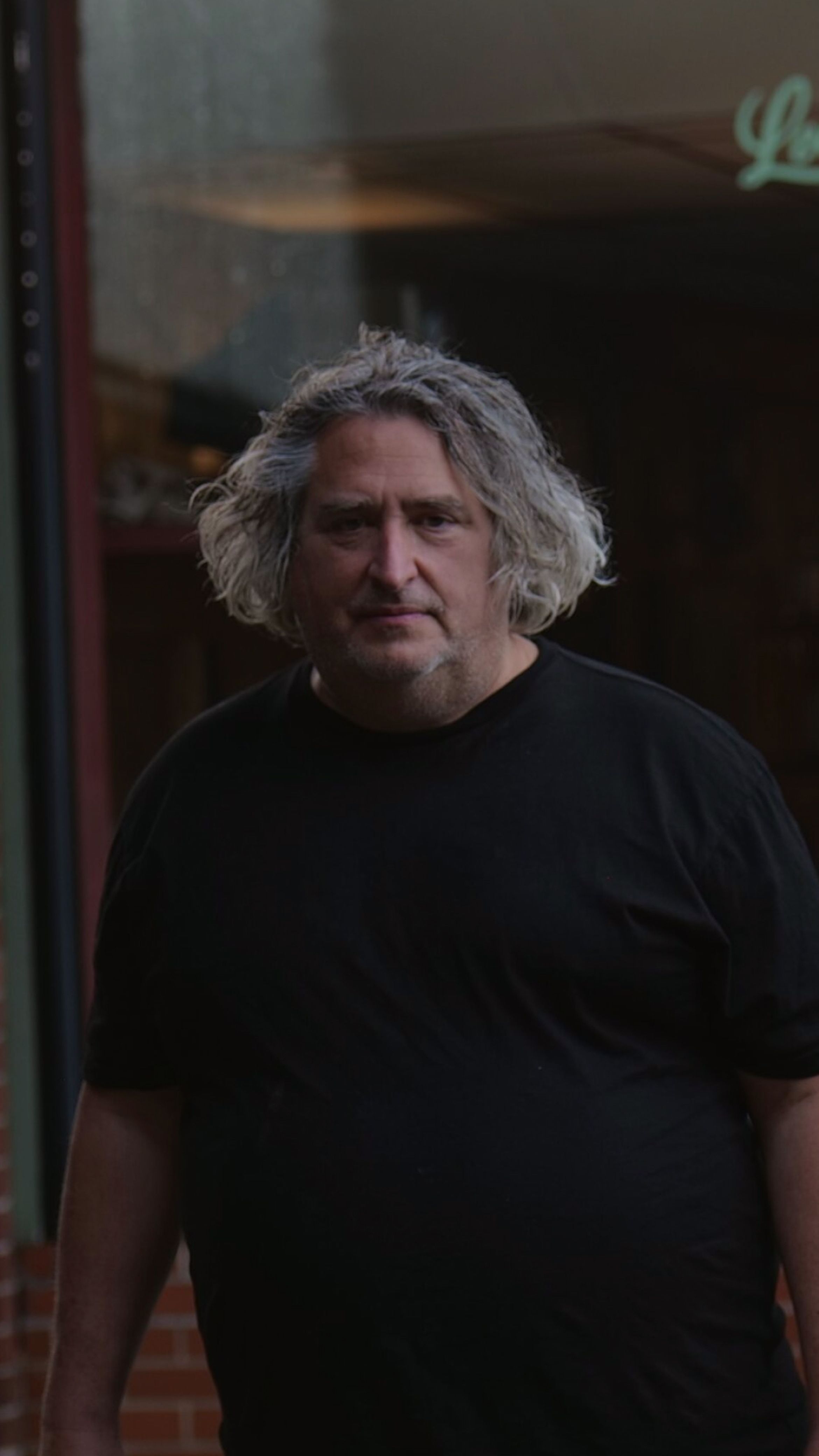
Mark Bradford’s art wouldn’t be the same if he wasn’t from Los Angeles. The city – like race, gender and class – clings to his body, and the materials of his paintings. His practice is often labelled ‘psychogeography’ but Mark prefers ‘social abstraction’. To him, the landscape is not just a concrete backdrop for our human dramas, but a complex web of people, places, and things we exist within and the systems that mediate them. In his mind’s eye, the city appears as a grid – man-made order imposed through historic redlines and crisscrossing freeways that divide people by race and class, like the Black neighbourhoods of South Central where he has lived for most of his life.
In 2006, Mark sat down in his studio in Leimert Park to tell the story of a city. Scorched Earth begins with an aerial map of one. For Mark, a map is not neutral. Historically, they have been central to the way we understand space and our position within it, but that has also made them tools of empire and conquest. Most maps erase the details that are not useful for their intended purpose, until even a sprawling metropolis like Los Angeles can become pocket-sized and legible. But Scorched Earth isn’t a map of LA, but Tulsa, Oklahoma. Mark’s initial interest in the city was because “it was an economic centre for Black commerce. Black people were doing real good in Tulsa”.
The first wave of African American migration to the area that would become Tulsa was along the Trail of Tears – a forced exodus of Native American tribes east of the Mississippi river under the Indian Removal Act of 1830. Among them were African Americans who belonged to the ‘five civilised tribes’ as either slaves, or through tribal membership as freedmen. Later, after the abolition of slavery in the United States, more African Americans left the South in search of greater freedoms and economic opportunities in the West. By the early 20th Century, there was a thriving Black community in North Tulsa. The Greenwood District became known as 'Black Wall Street' because of the many Black businesses that prospered there.
Nevertheless, economic prosperity did not shield Black Tulsans from racial violence of state laws, their white neighbours and the resurgent Ku Klux Klan. In 1921, Dick Rowland was arrested on allegations of assaulting Sarah Page, a white woman. Fearing that the young man would be lynched, Black Tulsans went to the county court house on 31st May where they were confronted by a white mob. Ultimately, Sarah Page never pressed charges but the arrest lit a spark that would burn Black Wall Street to the ground. That night, white supremacist vigilantes destroyed Black properties, murdered hundreds, and detained more than six thousand people.
In memory of this destruction, Mark disrupts the map of Tulsa with a huge swathe of intense black that represents both the physical and psychological scar of the Tulsa Race Massacre. Around Scorched Earth are small colourful figures that stand in for the varied and vivid lives impacted by the episode of white supremacist violence and arson. In the aftermath, an estimated 4,300 were left homeless, and many more unemployed. Mark says, “because I had lived through '92 (LA race riots), I felt a kind of a kinship with Tulsa and the destruction of an economic, true lifeline. I often wondered, where did they go? To other cities? Were they able to establish themselves in other cities and were they able to get loans”.
Because I had lived through '92, I felt a kind of a kinship with Tulsa and the destruction of an economic, true lifeline
Mark BradfordIn 1992, he watched as riots destroyed South Central LA. The catalyst was the brutal arrest of Rodney King by LAPD, but the community was already a pressure cooker after decades of systemic violence and neglect at the hands of the city. When the police officers who beat Rodney King were acquitted, the anger exploded as a wave of violence and destruction in Black neighbourhoods over several days. Mark recalls, “I remember the curfews in ‘92 and I remember us putting up sheets over the windows and still doing business because we had to make money.”
Although the perpetrators of the violence in Tulsa and LA differ greatly, the causes can be traced back to the racial organisation of urban space. For Mark, the aftermath looks the same – Scorched Earth, all-consuming, unsparing violence that scars the landscape. He admits, creating a work about Tulsa was in part “probably to deal with my own anger.” When Mark thinks of his community, his mind returns to the merchant class, often immigrants and African Americans operating “mom and pop shops” like the beauty shop he ran with his mother, or his grandmother who was a dressmaker. Because of that, he is “very interested in the ways in which local merchants navigate and sustain their lives.” Their experiences cannot be reduced to a map, and thus erupt out of Scorched Earth in lively abstraction.
Wherever he is in the world, he is drawn to communities like this. He recognises their patterns. The businesses are usually matriarchal, often transient – closing when the new landlord increases the rent, or a family member gets sick or moves back home. But they leave traces, in the form of memories or ephemera. Compared to the usual ebbs and flows of a community, events like the Tulsa Race Massacre and the LA riots are a rupture – an aggressive demolition that forces everyone to begin again. In LA, “a lot of those buildings, businesses were burned and some are only now coming back. It took 20 years.”
Although the original painting is two decades old, the work resurfacing as an edition feels prescient in the wake of the fires that have ripped through LA. “People will have a very different relationship to buying it here in Los Angeles, having just gone through scorched earth, than New York in Europe. But I think that people are experiencing the notion of scorched earth all over the world, I think we're in a moment of rupture.”